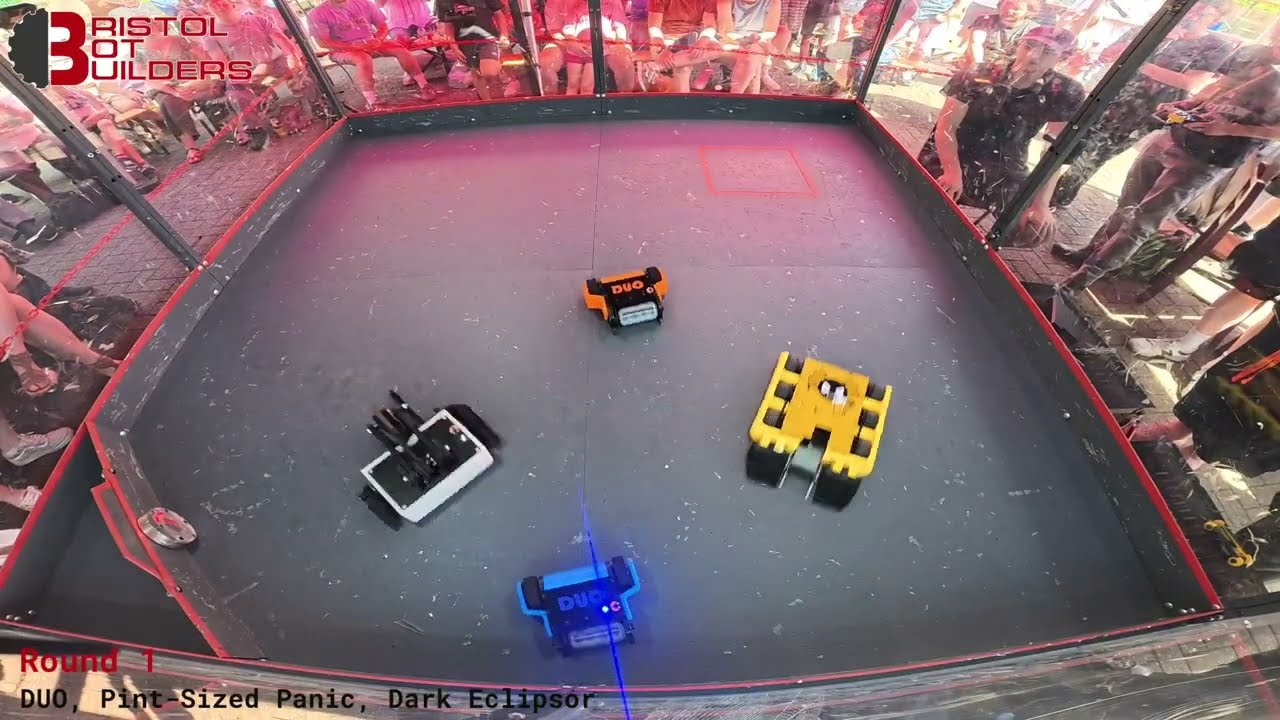
When I built my first beetleweight, Fatal Devitation, I had absolutely no idea what I was doing. Because of this I leaned into the two things I was fairly sure I could do: leverage my experience with RC cars and consumer product robustness testing build a tanky little robot that can take a hit and keep on trucking, and a fast, highly optimised drive system using my experience with electronics and microcontrollers to implement closed loop stability control using the gyro sensor in an IMU.
Once I was past the initial first robot teething issues I think I ended up nailing the brief - I had one of the fastest and most predictable driving robots around, and between some rough matchups at BBB and Robodojo events it went up against basically every terrifying big name spinner in the country, repeatedly getting its teeth kicked in but never losing functionality entirely - just lots of wheels. Unfortunately it wasn’t particularly competitive, as small control bots aren’t very good at controlling fights against bigger opponents, especially when forks are involved. Long robots also turn slowly, so despite its speed and drive control I spent a lot of time getting scooped up sideways and pinned against the arena walls. Finally, the weapon was weak, with a geometry that suits a high power flipper (like Fatal Deviant now has) but without the space for a servo big enough to back it up, so even a successful pin was rarely followed by a decisive lift or flip.
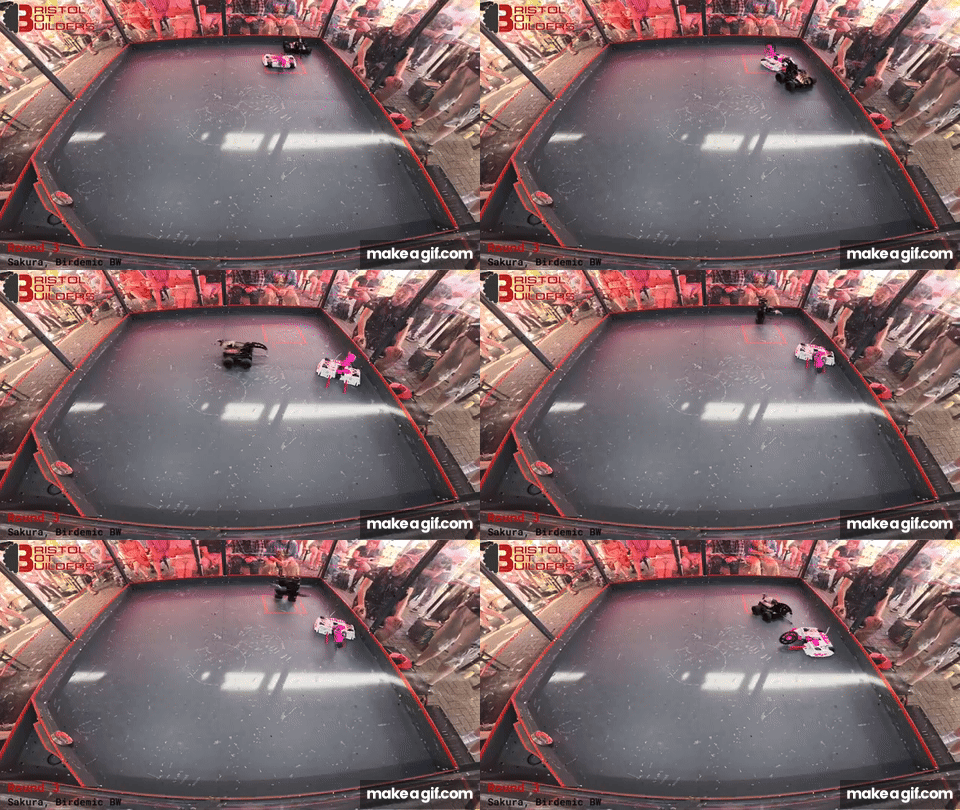
Fast forward to last year, and I debuted a silly little brain fart antweight crusher/grabber called Birdemic. While the little crusher arm (pecker) isn’t really powerful enough to do any significant damage*, it causes a moderate amount of psychological damage, and I’ve had multiple opponents panic and drive themselves into the pit while locked together, despite not having quite enough grip to properly control an opponent that’s caught in the pecker. Like the previous bots, it’s again usually one of the fastest bots wherever it goes, and the closed loop drive makes it extremely predictable and precise to drive. The ground game with the tiny titanium forks is also excellent, even sometimes winning head to head against acetate. The result is a really solid little control bot that’s faster and more manoeuvrable than many of its opponents, and has led to me developing an extremely aggressive driving style, where (if it all goes right for me) I’m using the entire arena, constantly orbiting my opponent, forcing them to pivot defensively and waiting for them to make a mistake and show the rear or side of their bot. If the engagement is bad for me, I’m often able to back away and reposition before my opponent can capitalise on it. A really good example of this is an extremely technical back and forth fight I had against Grey Fox 2 at January GROCS
*I didn’t know at the time, but I closed the pecker into the weapon motor of Falcon 2 during the final rumble at the last ORCS, and apparently killed it, which means I’m definitely going weapon to weapon more in future.
While antweight Birdemic was initially just an exercise in building something kinda weird, having rolled into it everything I learned from developing Fatal Deviation (and its little antweight counterpart, Fatal Deviant), followed up with much iteration, it has ended up becoming my most successful robot yet, with a 2nd place at GROCS, 4th at Ant Freeze (or 6th, depending on if you look at the bracket or points - double elimination is weird), and even sometimes winning fights at ORCS under its belt.
Considering how much I enjoy driving antweight Birdemic, and seeing how Fatal Deviation’s development had plateaued and left me with a solid and reliable but not particularly competitive robot, it made a lot of sense to me to scale the little antweight up to a beetleweight. After some thought, I ended up with the following requirements:
- Normal size. Fatal Deviation is tiny, and I really enjoyed the technical challenge, but antweight Birdemic really benefits from being in the same size range as most of its opponents. The forks can be longer in proportion to the body without becoming unwieldy, and everyone loves a big pecker.
- Bouncy robot. Structurally Fatal Deviation is mostly 2mm 304 stainless steel, which makes it slippery and hard for a spinner to get a good engagement (and if the teeth on my poor bandsaw are anything to go by it’s basically saw-proof), but one good hit to the chassis tub causes it to bend and leaves me with only two or three wheels touching the ground, even if they all still work. Big hits usually result in me hammering the tub flat again, and in one instance after a whiteboard with Frenzy in full send mode I was nearly totally unable to non-destructively remove the internals from the tub. Similarly my antweights are all PLA-ST, so I have no real bouncy bot experience.
- Big ground clearance. Like everyone I hate getting stuck on forks, and I feel like being able to drive right over the top of them is my best bet at avoiding them.
- Even faster drive. Almost every event I’ve taken Fatal Deviation to I’ve had a “wow it’s fast” comment, but people are starting to get used to the speed and I need to keep everyone (including myself) on their toes.
- Spicy grabber. Crushers are great, there’s little better than watching a robot slowly get squished into oblivion, but they tend to be slow to actuate, so opponents can escape before the crusher is fully engaged. At smaller scales they can also be mostly countered by a few millimetres of carbon fibre or metal. Grabbers are great, but they don’t typically cause any direct damage. What if, like the antweight version, I split the difference? Rather than hundreds of kilos of force and seconds of actuation time I can aim for dozens of kilos and milliseconds of actuation time instead and still cause a headache for anyone running a thin HDPE or TPU top plate. Just enough spice for people to consider switching out their config for more top armour. Fast actuation time also means I can integrate self righting without any extra mechanisms - a carbon fibre rod in the pecker base is enough to pop it back over onto its wheels when the weapon is actuated.
- Enough traction to really take advantage of the pecker and take an opponent coast to coast into the arena wall while held tight. This is something I have always wished the antweight could do, but my aversion to polyurethane tyres (I have a history with moving out of places and leaving behind cured polyester/epoxy resin stuck to driveways and paving slabs) means I’m stuck with lego tyres, which aren’t quite so competitive at antweight scale, and grabs usually end up as a tussle for grip, with both drivers having some say in the direction we go but neither having the control to either fully aim for or avoid going down the pit.
Since antweight Birdemic uses 24mm Lego tyres, I picked the 68mm flavour for Big Birdemic. This set a rough scale factor, and thrashed out some CAD to figure out packaging. Thankfully it appeared everything fit, so I threw an entry in for New Bloods and crossed my fingers. I quickly received an offer of a reserve spot, and figuring that a reserve spot at New Bloods had a better chance of making it to full competitor than at any other event I accepted it, again crossed my fingers, and got stuck in with the design work.
Just as I was on the home stretch with the initial design of the bot, and around the PoM deadline, I got the email I was hoping for - someone had dropped out and I was being offered a full competitor spot! Despite being ready for PoM the robot was absolutely not ready for combat, so I got my head down and started really hustling, with basically every ounce of free time being dedicated to robot stuff.
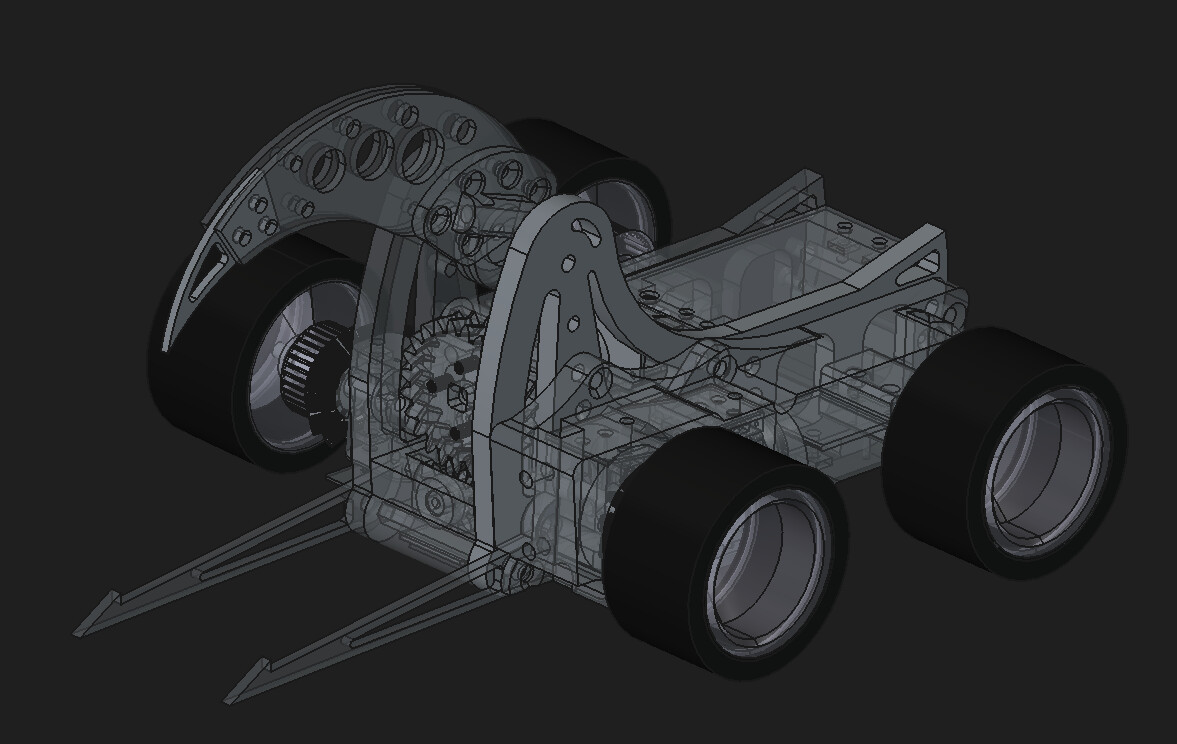
Here is the design I settled on. 120mm wheelbase and 235mm overall width gives me a robot that’s squarely in Normal Beetleweight Size Range. Construction is much more typical also, with 8mm HDPE uprights and 3D printed chassis parts. The side pods that contain the front armour mounts slide over and cover the drive motors are held in place with standoffs that pass through the centre sections of the bot.
Like most of my other robots it uses bevel gears to drive the front wheels, with integrated pulleys printed into the wheels for HTD3 belt drive. Drive is by two Repeat Maxes, with the 1900KV version chosen both for 6s compatibility and also with the lower KV motors better matching the enormous monster truck tyres.
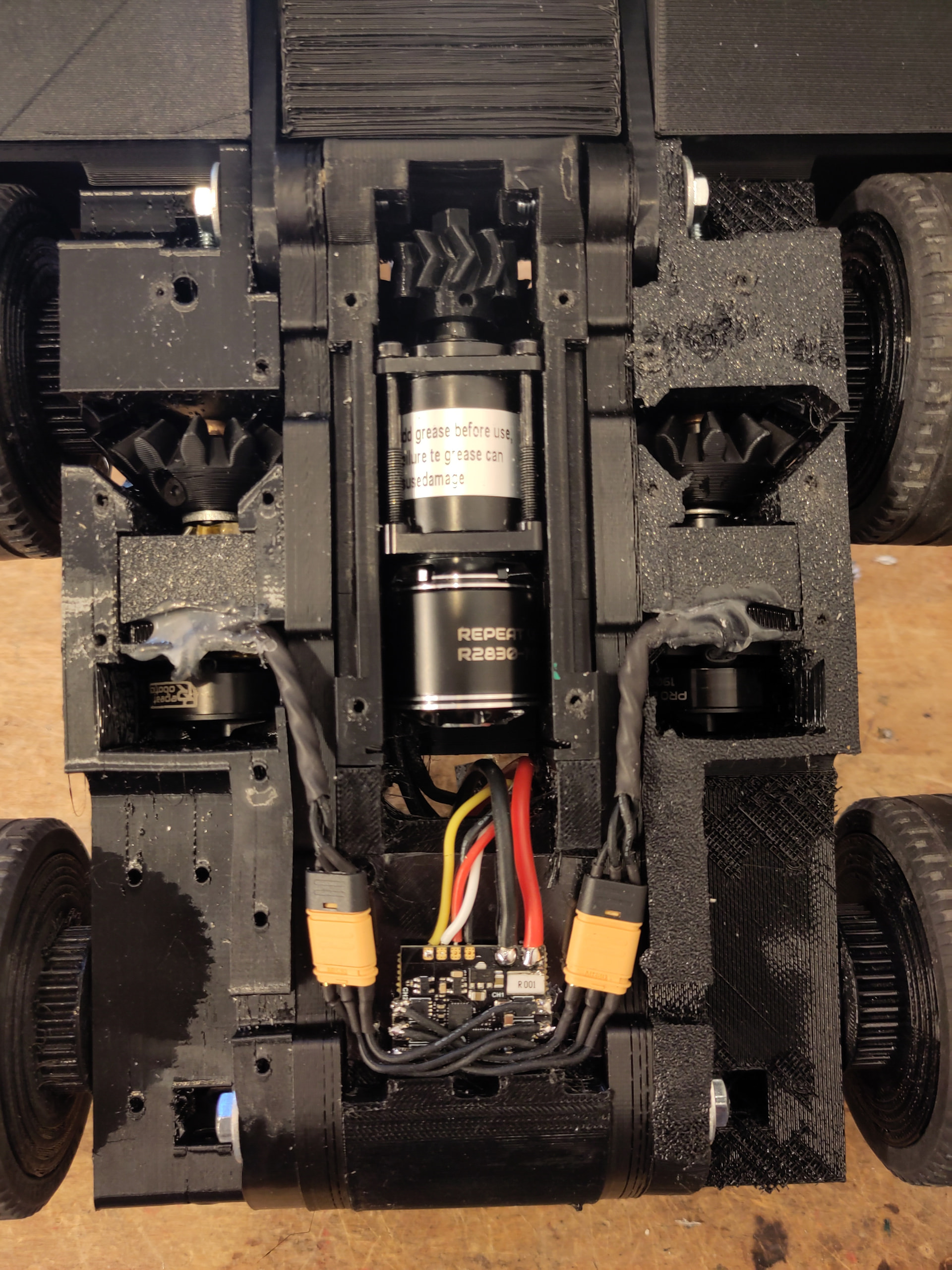
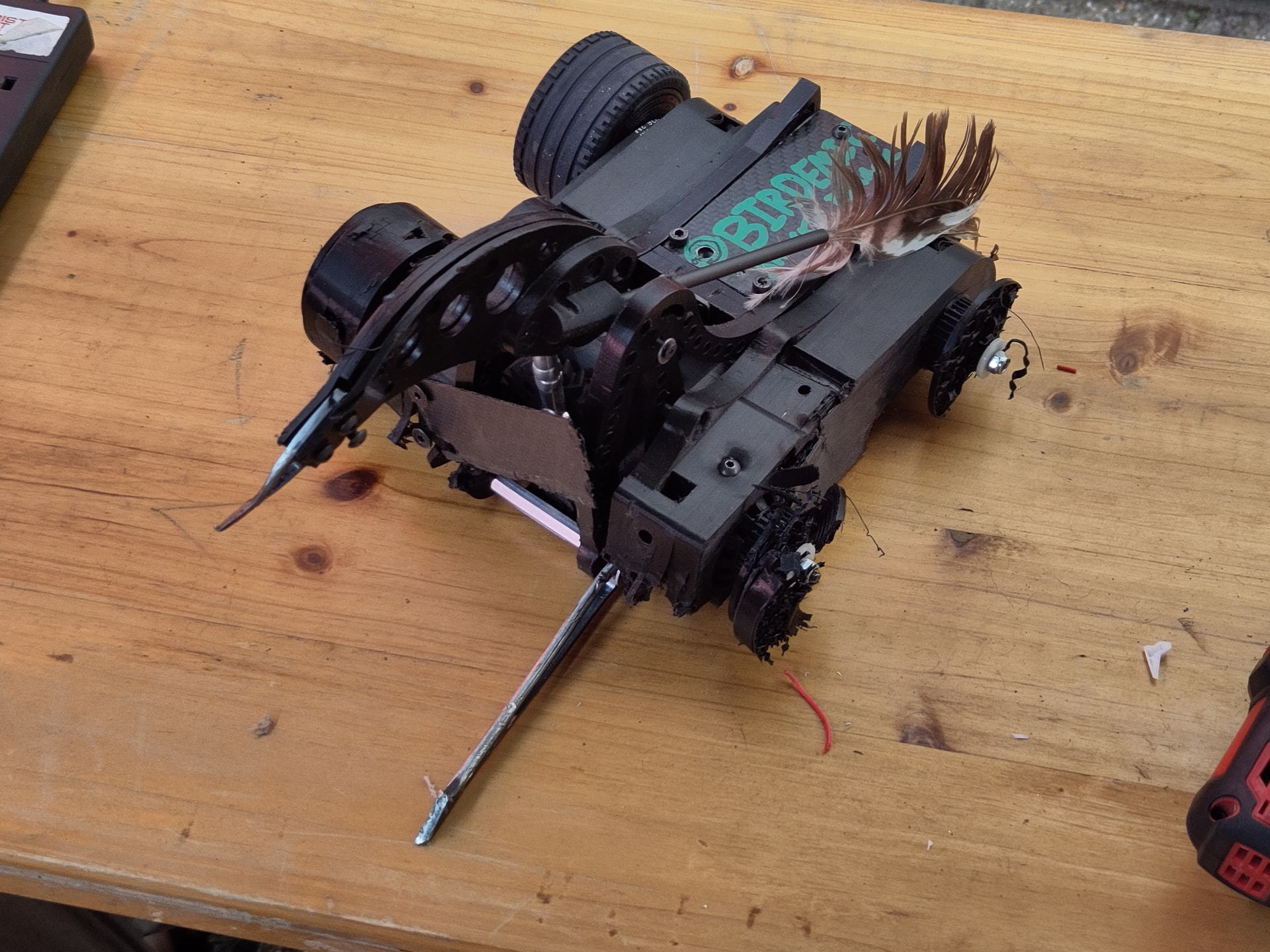
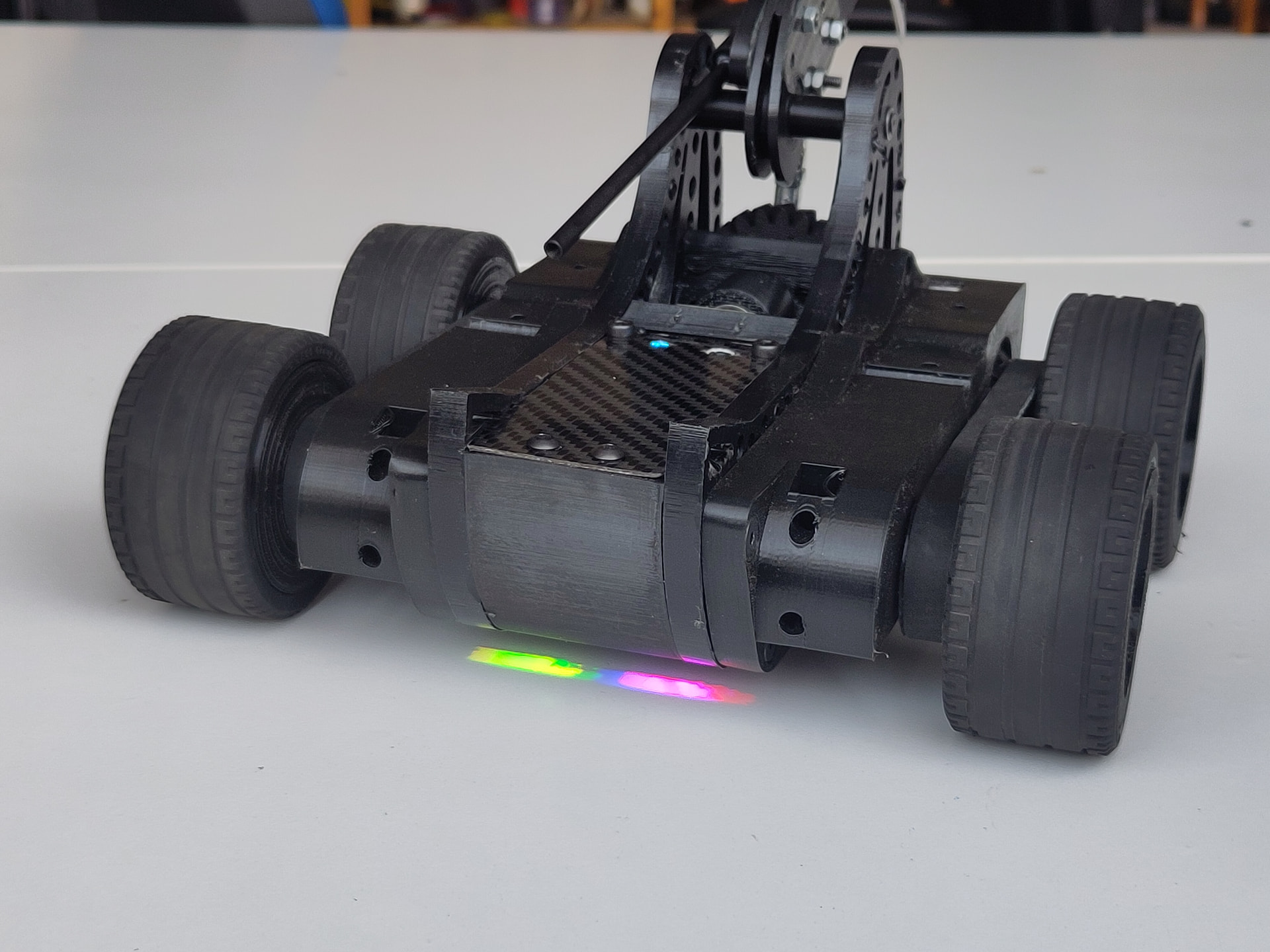
The photo above is the first revision - I tried to copy the pocketed design I use for the antweight bots, but there was far too much flex and the TPU gears on the wheels were audibly slipping even on my shiny kitchen floor. It’s possible I could have made the printed geometry work with more walls and infill, but it’s not a weight efficient way to do things.
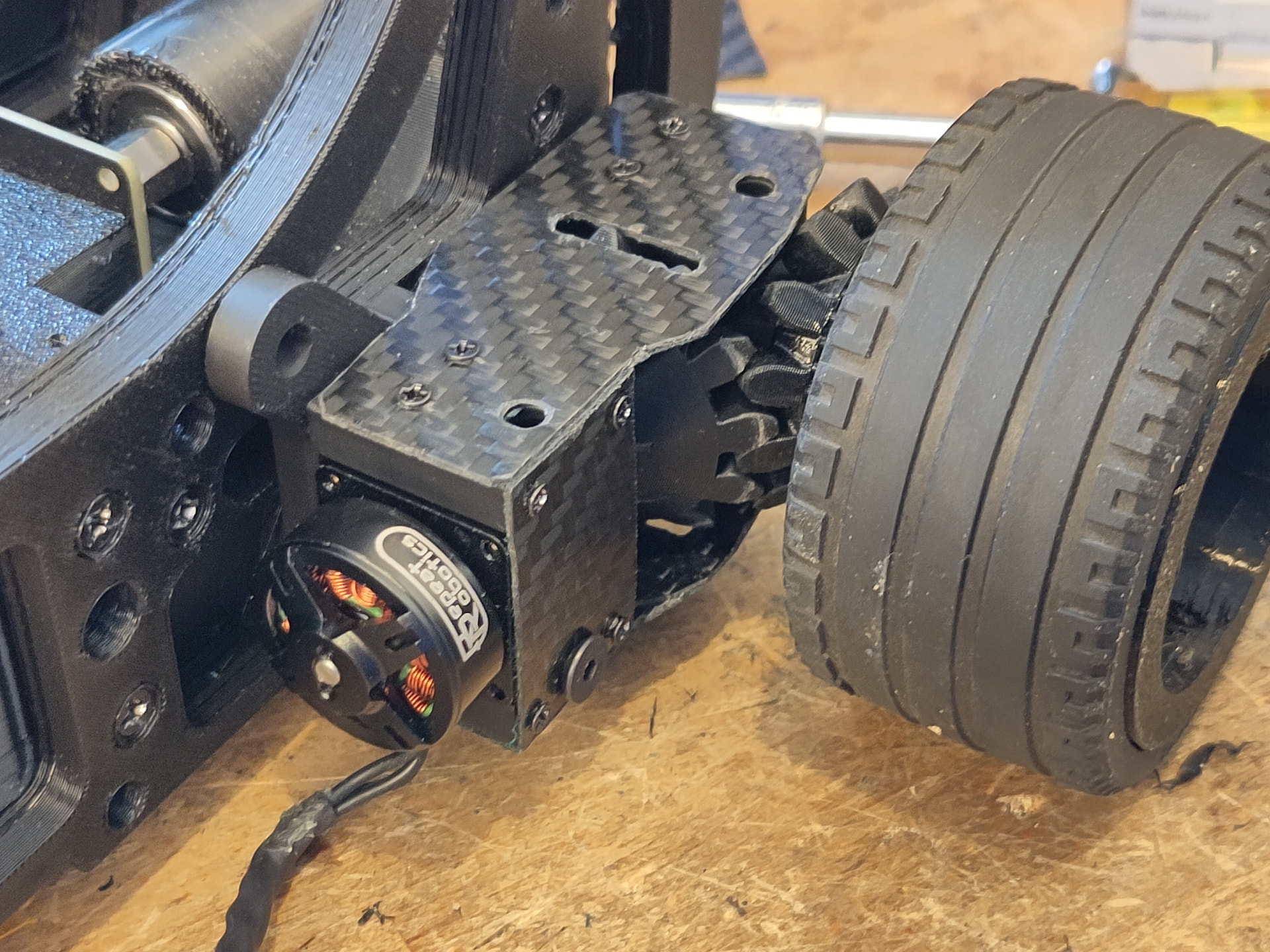
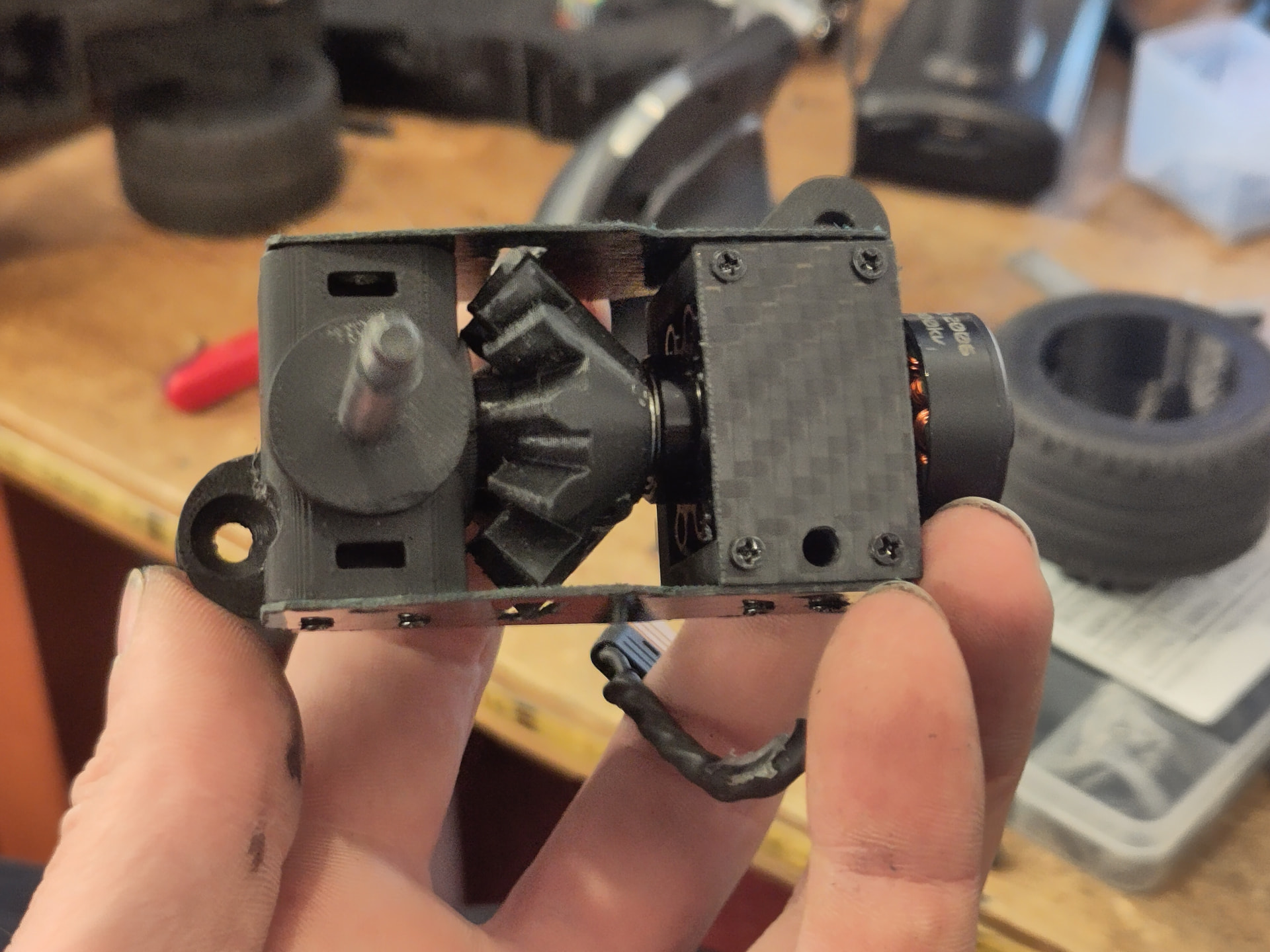
Instead I designed some motor mounts from TPU, which clamp the motors tightly and use a bronze bushing to support end of the motor shaft as close to the wheel axle as possible. The TPU parts are joined using pieces of Tepex (plycarbonate/carbon fibre composite, like Tegris but less good) to add stiffness in the desired axes (preserving belt tension and gear mesh) while allowing flex in all the others, and the final assembly is mounted to the uprights via standoffs and captive nuts pressed into the centre section that holds the weapon motor.
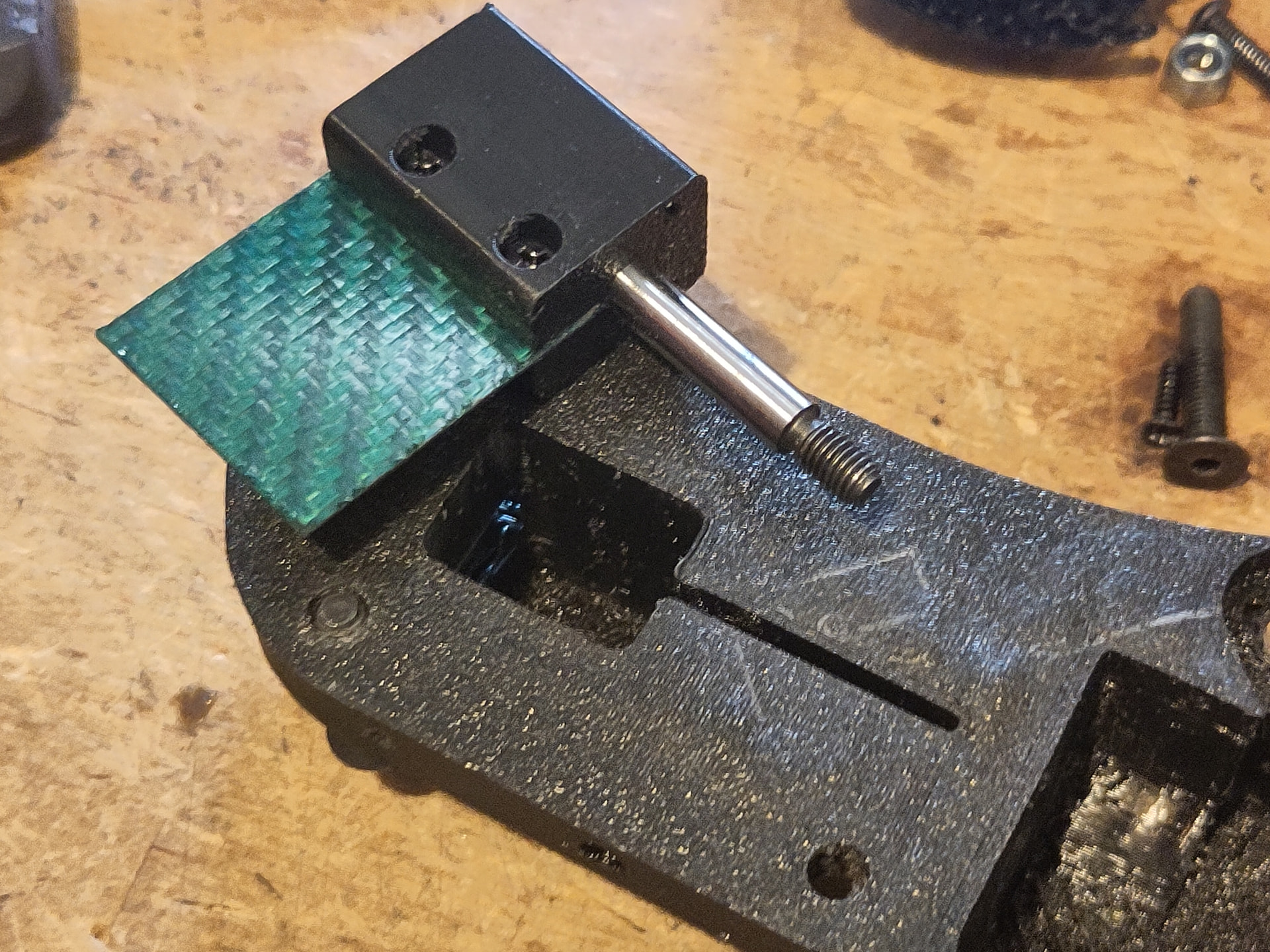
I had similar issues with rear axle flex too, as the ideal belt tension stretched the drive pods to the point that the wheels all pointed in different directions, developed a lot of friction, and the belts skipped anyway. I solved this with some Tepex stiffening pieces which screw into the PLA-ST axle holders and brace them against the HDPE chassis. Like the front motor mounts this gives them stiffness in the direction of the belt tension but allows compliance in all other axes. These slide into the printed pod covers - no fasteners required.
Tried to avoid spoilers but this exploded view (courtesy of Tonk) is really useful.
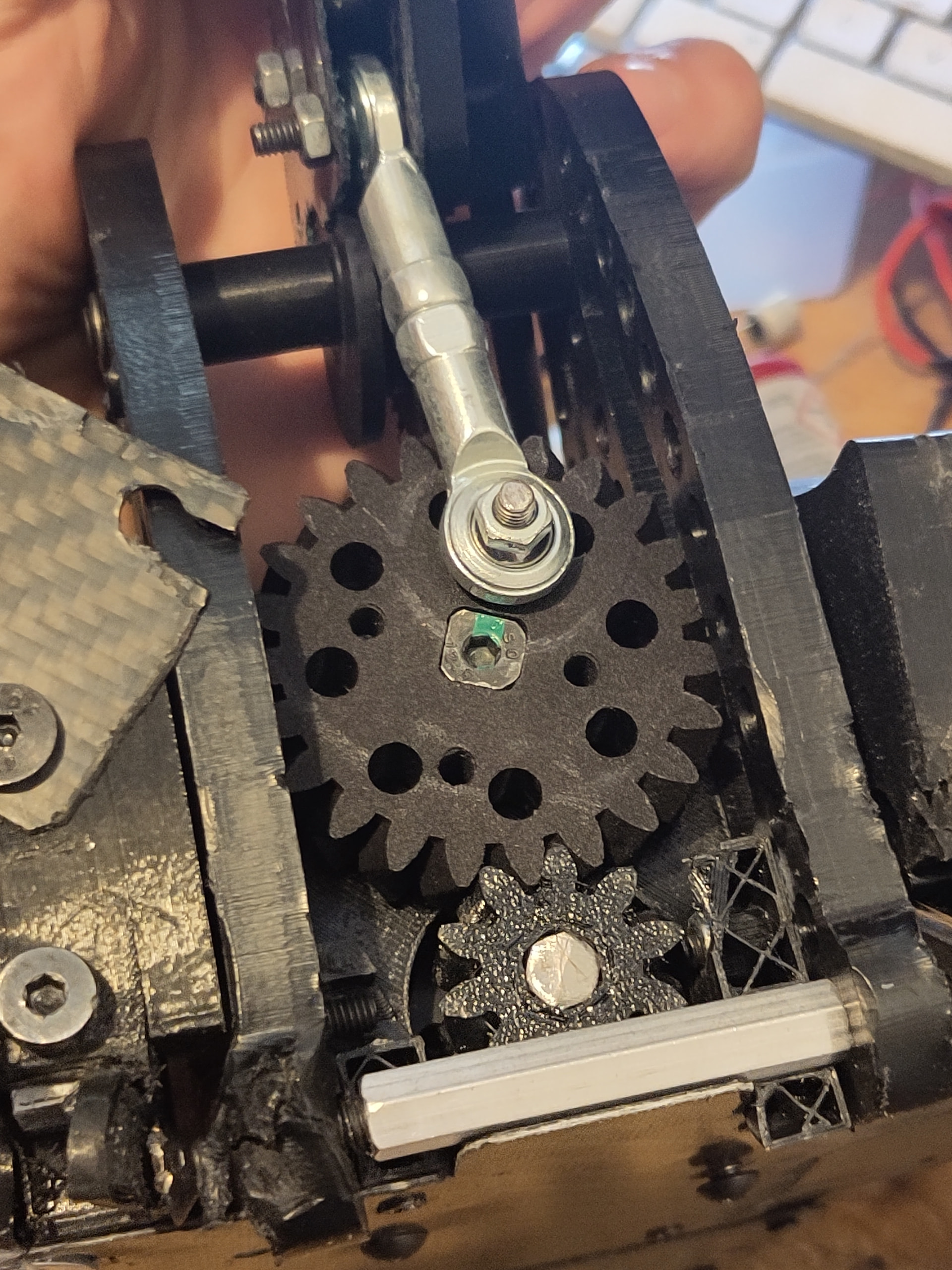
The weapon is driven by a 51:1 Repeat Ultra, often used to drive 12lb lifters and hammersaw arms. While watching NHRL I’ve seen 12lb robots jump in the air while self righting, so I figured this would be more than enough power. While the packaging of the motor and gearbox means the orientation is different to the antweight Birdemic’s servo + linkage assembly, the mechanics are essentially the same - a continuous rotation crank pulls on a linkage which is attached to the arm, which should efficiently couple the output gear to the arm while avoiding any issues with driving a powered motor into a physical endstop while being far more robust and easier to package than trying to use gears to drive the pecker directly.
Due to the forces involved and the gear mesh required, the weapon motor pod is the only part that’s not printed from flexible filament - instead this is PLA-ST. Since it’s not designed to take any direct hits this is ok, although evidently it did take some direct hits as some of it is now missing!
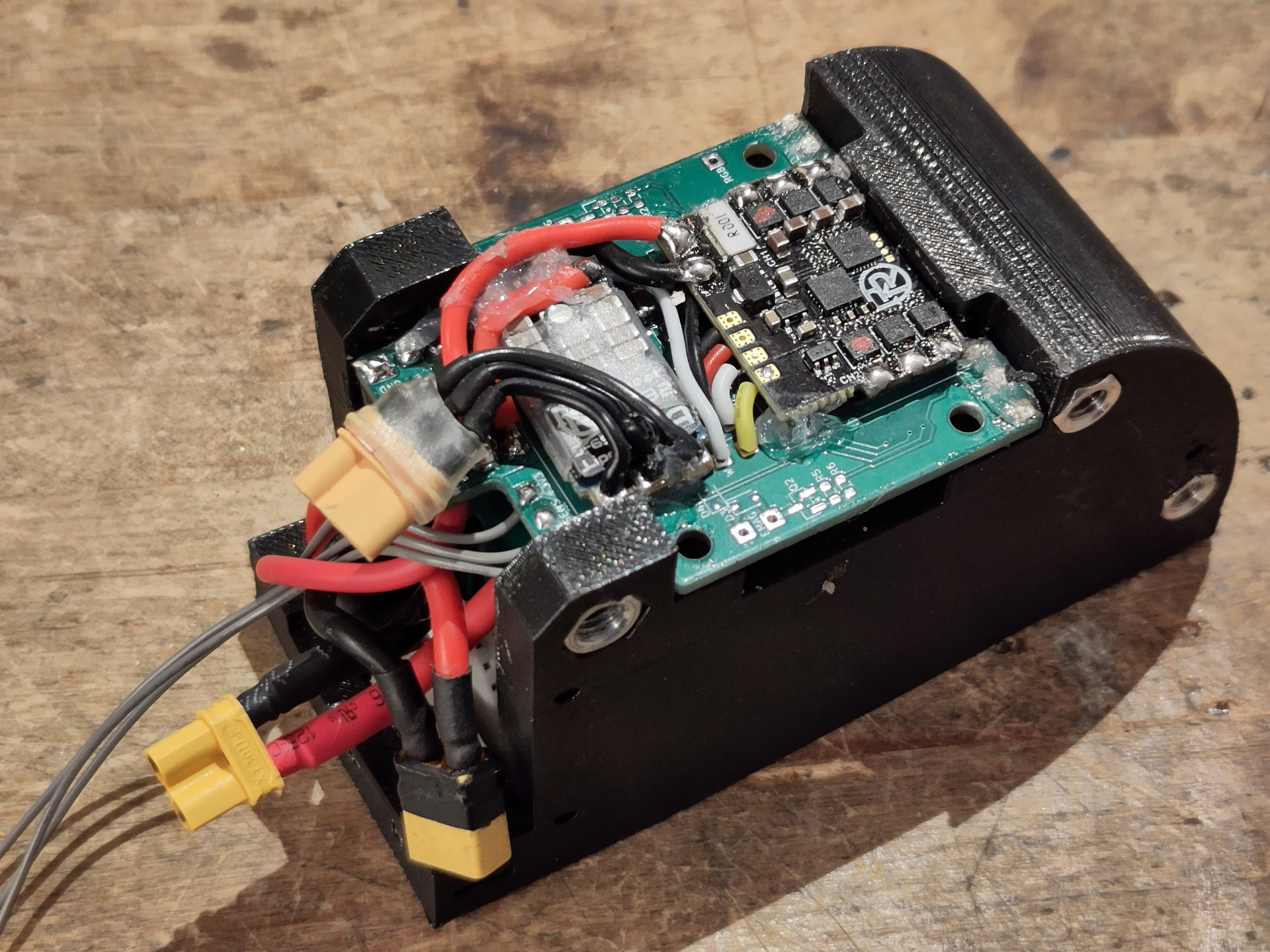
Like my other bots there’s a PCB onboard, and like Fatal Deviation I settled on a Seeed Xiao RP2040 as the microcontroller of choice, with the same LSM6DSV320X IMU I use in Birdemic and Ultimate Ninja for stability control (the Fatal bots use an MPU6050 but this is out of production now and I’ve run out of dev boards to steal chips from). Unlike Fatal Deviation I didn’t implement my own drive electronics, instead opting to use a Repeat dual for drive and a Repeat 35A for the weapon. The PCB is used for power and signal distribution, meaning there’s no real wiring loom inside the bot - just a central pod that contains the battery and all the electronics, aside from an MT6701 magnetic position sensor for weapon position feedback to the microcontroller.
This sensor and a diametrically magnetised magnet on the inboard end of the weapon gear shaft are what allow me to have the weapon open and close with soft endstops just like the antweight version - it’s not true position control, but it doesn’t need to be. I picked the MT6701 since it has an analogue output, which is a lot less risky to connect into the MCU than bringing something like I2C off the PCB and risking a short that locks up the bus and crashes the microcontroller. I do use a watchdog timer and multiple layers of software contingency, so it wouldn’t be a safety issue, but it would send the bot into failsafe mode and end my zero combat-related electronics failure streak (we don’t talk about benchtop reverse polarity incidents at home). As it is, if a wire breaks or the sensor takes a hit, the weapon can still run in open-loop (timed) or continuous rotation mode.
Of course, since there’s an MCU and a PCB it has RGB underglow. Like Fatal Deviation the RGB acts as a status light that I can see while driving (unless it’s outdoors where it’s too bright to see the LEDs), which it switches from rainbow to blue if the receiver loses connection, and to red if the battery is low.
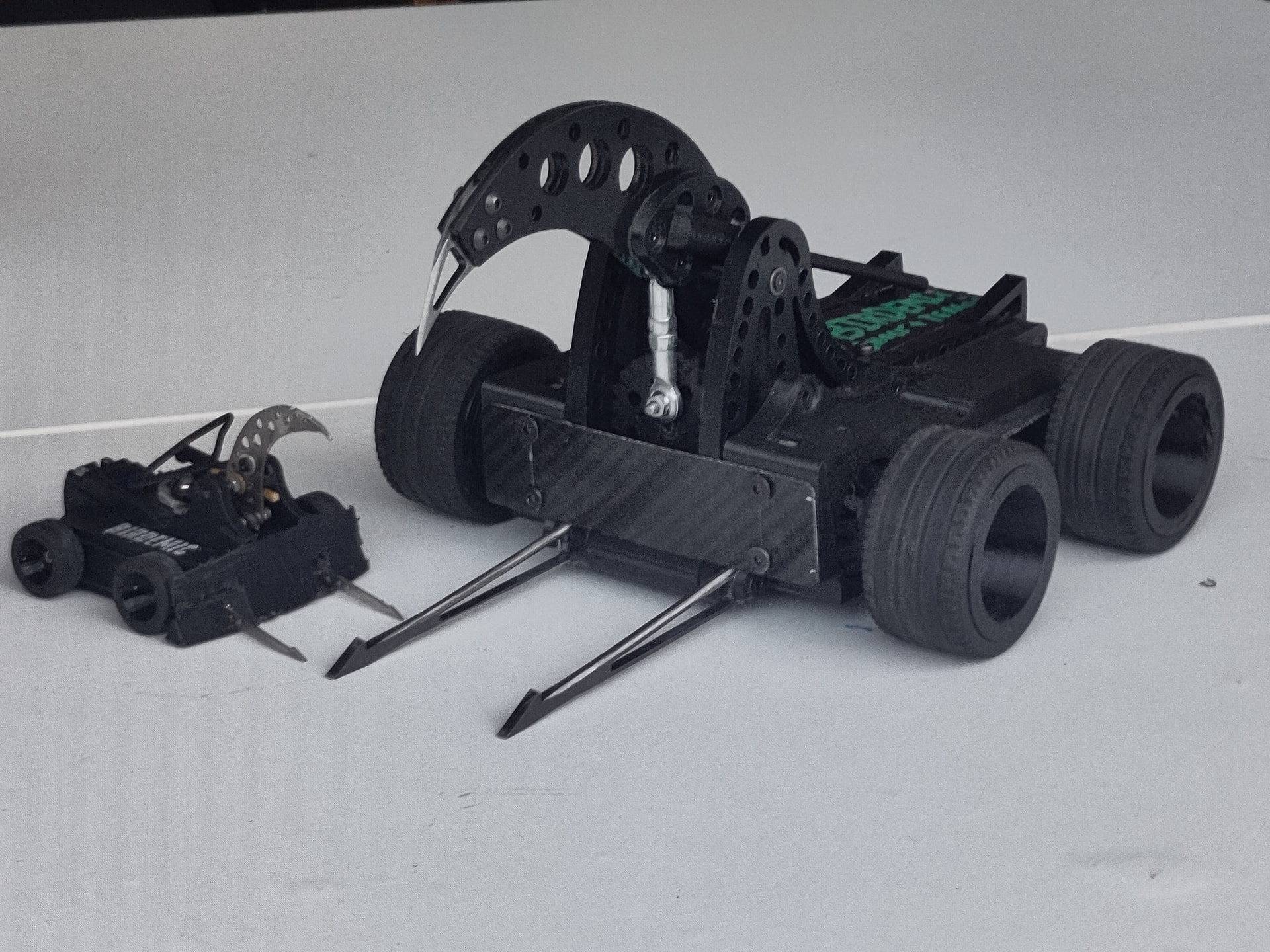
Anti-control bot config
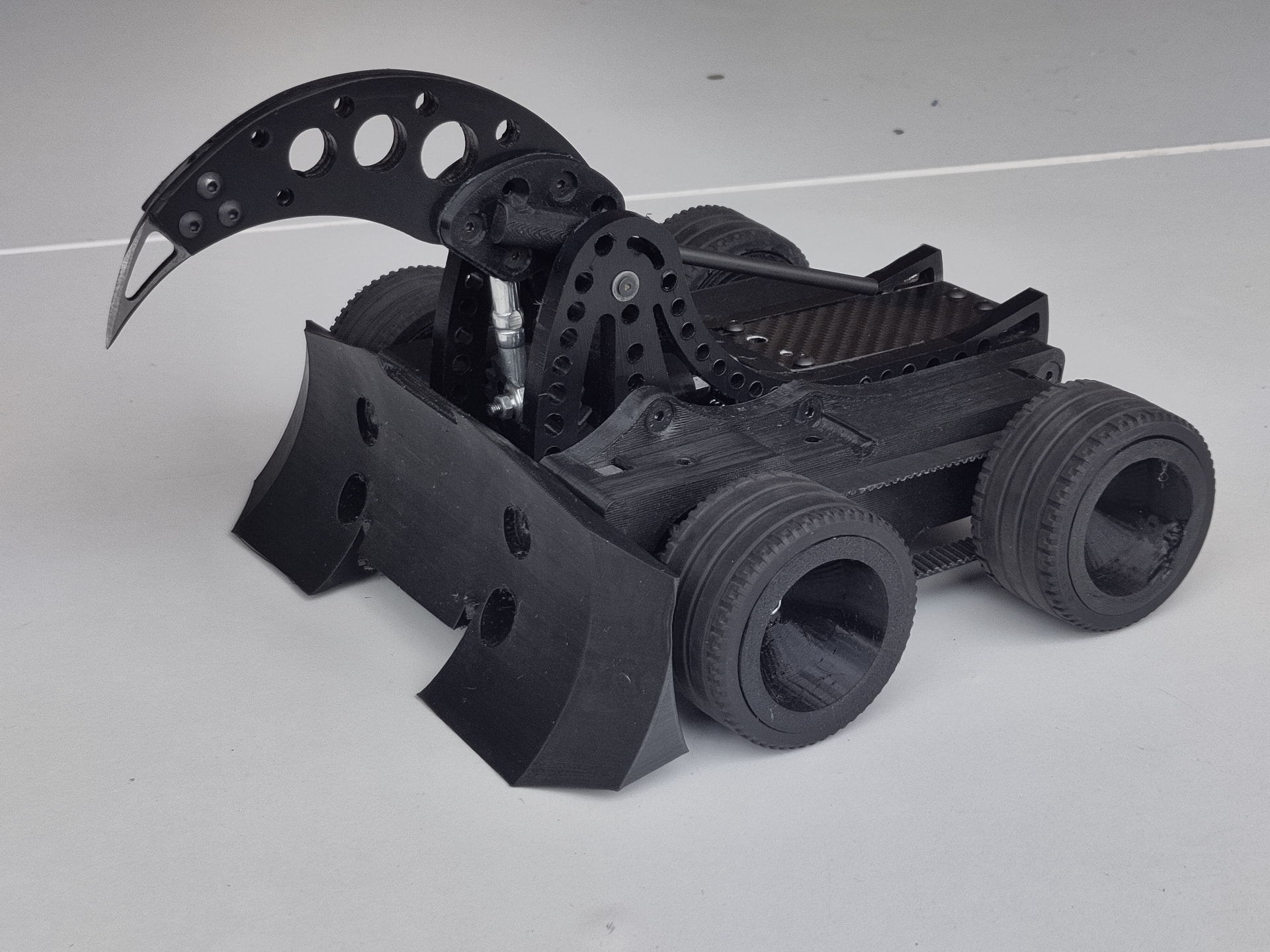
Anti-horizonal config (no weight left for horizontal-compatible forks but I have some ideas)
Much more hyperfocus and much less sanity later (CAD stands for Crying Aided Design), this is what I ended up with. It’s big (for me), it’s fast, it’s bouncy. In fact it’s extra bouncy, as I ended up printing most of the flexible parts from PEBA. PEBA is like TPU++; it’s much bouncier - when used as a spring it returns 70% of the input energy (TPU is about 20% iirc), and about 20% less dense, at the expense of lower layer adhesion and costing twice as much per reel as the Overture TPU I usually use.
The lower density was the main reason I had to go for PEBA, as weight limits are brutal and I was heading for a 1600g bot. As it is I narrowly scraped in under the weight limit (with some careful switching of front ends and battery covers depending on opponent), but only after an obscene amount of weight reduction - I ended up having to remove some parts, eliminate some hardware, shorten some screws, swiss cheese the uprights and wedge mounts on the pillar drill, and take about 5g out of each fork by removing some meat and filleting all the corners (aside from a leading edge) to a ~2mm radius with an angle grinder. I also had to drop down from a 6S 700mah battery (definitely overkill) to a 5s 450mah battery, which thankfully seems to be just enough capacity to last two minutes, although an extra cell would be nice for even more high speed chaos.
I had also originally intended to install electromagnets on the rear axle, hanging below the chassis almost to the ground, giving me an extra kilo or so of downforce on the rear axle for straight line traction and keeping the rear planted during grabs, while turning them off to allow drifting during turns or to keep things moving smoothly when missing a rear wheel, but at 30g each these were unfortunately the first thing to go.
Uncharacteristically for me (but hopefully more characteristic going forwards) the vast majority of the robot was together and ready a whole day early! How did Birdemic do? You’ve probably seen the event video by now (or even better, you were there drinking beer and watching robots fight in the sun), but stay tuned for part 2…